
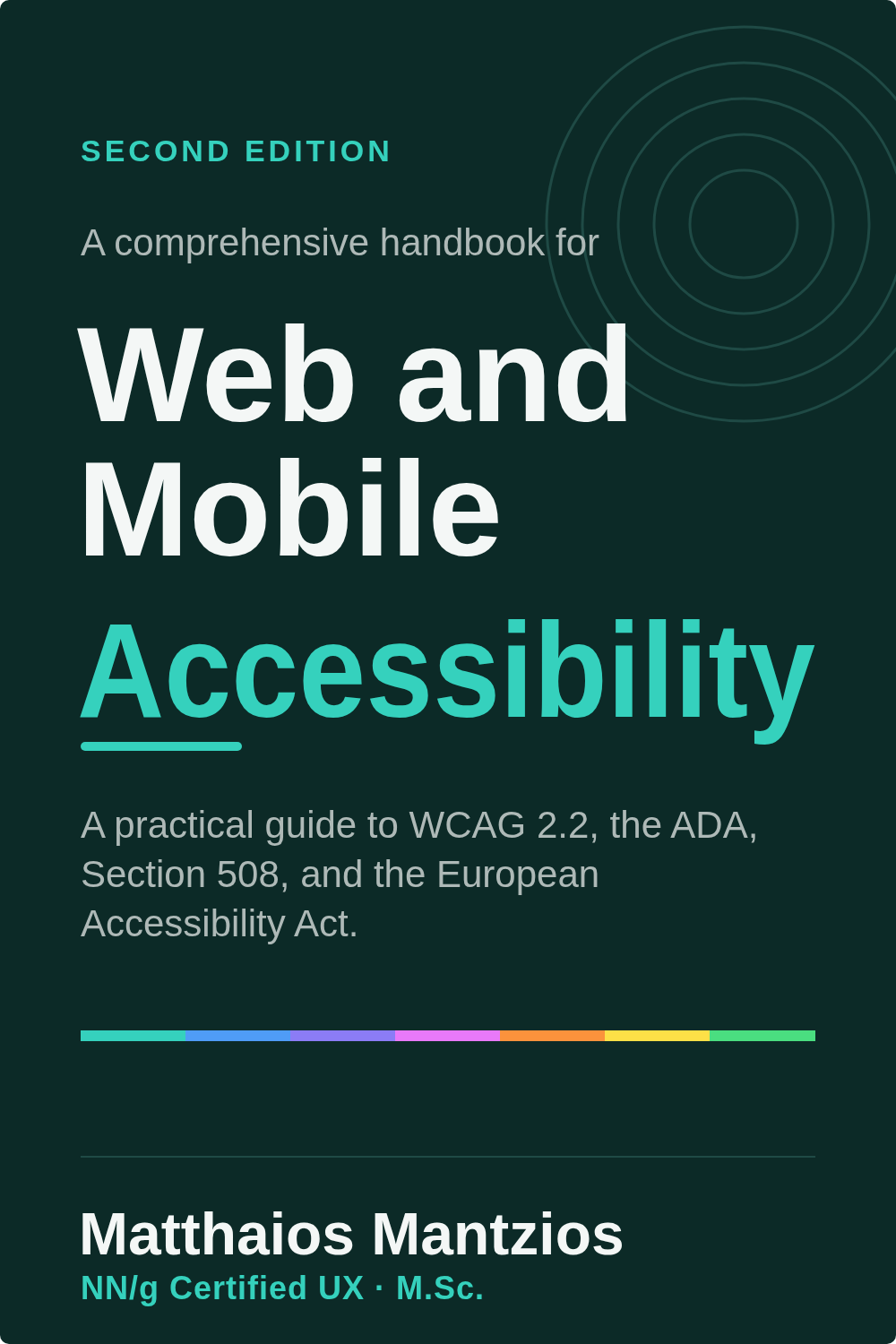
Web and Mobile Accessibility
A Comprehensive Guide to WCAG 2.2, the ADA, and the European Accessibility Act
A compass, not a checklist.
16 chapters and 4 appendices
Foundations
- Understanding disabilities and impairments
- Going beyond the basics
- Mobile accessibility
- Advanced techniques and tools
- Real-life examples and case studies
Process
- Integrating accessibility into the development lifecycle
- Advanced and automated testing in depth
- Emerging technologies
Law and standards
- The legal and ethical landscape worldwide
- What WCAG 2.2 changed
- Understanding the European Accessibility Act
- Acting on the EAA — a business playbook
Practice
- Designing for cognitive and learning disabilities
- Accessible patterns for the components you build
- Accessible data
- Testing with the people you're building for
Appendices — A: WCAG 2.2 AA checklist · B: what automated testing can and cannot catch · C: EAA readiness checklist · D: accessible documents. Plus a glossary.
Chapters 11 and 12 are the reference behind the EAA work on this site — the Greek enforcement analysis on Πρόστιμα EAA στην Ελλάδα, the EAA Exposure Report and the EAA document toolkits all draw on the same material, documented here at length.
Written to be used, not shelved
- Seven personas across the disability spectrum ground every chapter — including Sophia, a blind software engineer who codes by touch and sound.
- Recipes for the components you actually ship — modals, tabs, menus, comboboxes, tooltips, carousels — with keyboard and screen-reader behaviour spelled out.
- Testing that finds real barriers, including testing with disabled people, on the stated basis that automation alone catches a third to a half of issues.
- Honestly sourced — directional data flagged as directional, never dressed up as proof.
From Chapter 11 — "The penalty picture, told honestly"
Penalties are where misinformation is thickest, so it is worth being careful. The EAA does not set a single EU-wide fine. Article 30 requires only that penalties be "effective, proportionate, and dissuasive," that authorities weigh the severity and duration of a breach, and that any penalty be paired with a duty to actually fix the problem. Each member state then sets its own numbers, which is why the figures vary so widely.
Be skeptical of the scary numbers. You will see "up to €250,000 per breach" and even seven-figure sums quoted across the web. Many of these come from vendor marketing, not primary legislation, and the widely repeated "€250,000 per breach" figure does not appear in the Directive at all. The figures that are confirmed against national law are more modest — and still serious.
- Germany (BFSG) — administrative fines up to €100,000 per violation.
- France — €7,500 per infraction for a legal entity, doubling to €15,000 for repeat offences, with product withdrawal available to authorities.
- Italy — up to €40,000, or as much as 5% of turnover, under its extended Stanca Law framework.
- Ireland — fines reaching into the low hundreds of thousands, and — unusually — possible imprisonment of company directors for persistent, wilful non-compliance.
Treat any figure you cannot trace to a national statute as marketing until proven otherwise.
Greece is absent from that list for a reason the book and the site both document: the presidential decree that would set its penalties has not been issued. See Πρόστιμα EAA στην Ελλάδα.
Get the book
Sold through Amazon. Kindle is often on promotion — check the current price on the listing.
Transcript
The current line highlights as the video plays. Activate any line to jump the video to that point.
The European Accessibility Act has applied since June 2025. The Web Content Accessibility Guidelines, version 2.2, set out what conformance looks like. Neither document tells you how to run the audit, or which finding to fix first in your own product. That gap is what this book covers.
Web and Mobile Accessibility: A Comprehensive Guide to WCAG 2.2, the ADA, and the European Accessibility Act.
You will learn how the Web Content Accessibility Guidelines map onto the European Accessibility Act and the Americans with Disabilities Act, so you can separate what is legally required from what is good practice. You will learn how to run an audit, write findings a developer can act on, and order them by user impact. And you will learn how to build accessibility into a design system, so the same defects do not come back in the next release.
It is written for the designers, developers, and product owners who have to make these decisions inside real projects. Second edition. Available on Amazon in hardcover, paperback, and Kindle.
A 73-second introduction to Web and Mobile Accessibility, second edition — what the book covers and who it is for. Captions can be toggled with the CC button in the player; the transcript alongside follows along as it plays.
Put the book to work
The same expertise, applied to your product: explore accessibility & UX services, run the free EAA & WCAG readiness checklist, or get a fixed-scope EAA Exposure Report.
Interviews and review copies
Matthaios Mantzios is Head of UX & Design at ITML and founder of UXellence, an NN/g-certified UX practitioner with an M.Sc. He can speak on the European Accessibility Act and its enforcement in Greece, WCAG 2.2 in practice, accessibility in design systems, and testing with disabled users.
Review copies on request — matthaios@uxellence.gr.